Sunday, August 16, 2015

A Day in Berlin

We were lucky.  The temperatures did moderate for our walk around Berlin...it actually was around 80 degrees.  Our ambitious walk started out at our hotel to follow the path of the Berlin Wall through town to Checkpoint Charlie, check out Unter Den Linden Boulevard, then through the Tiergarten and back to the hotel.

As it turned out, the wall ran very close to the hotel, just a couple of blocks east.  It is commemorated in two ways:  in some areas, the path is marked with bricks set into the pavement and in other areas actual pieces of the wall are preserved.  We started out following the bricks next to the river:


The path of the wall let us to the Reichstag building.  This is the historical building constructed to house the Imperial Diet (in German that's Reichstag).  It was opened in 1894 and housed the Diet until 1933, when it was severely damaged in a suspicious fire. After World War II, the building fell into disuse; the parliament of the German Democratic Republic met elsewhere, while the parliament of the Federal Republic of Germany moved to Bonn.

The ruined building was made safe against the elements and partially refurbished in the 1960s, but no attempt at full restoration was made until after German reunification in 1990.  It then underwent a reconstruction that was completed in 1999 when it once again became the meeting place of the German parliament: the modern Bundestag.  There's a public restaurant inside that looks across the street at Angela Merkel's office.  We heard that she wasn't there...she was off handing out money to the Greeks.  Needless to say, security's tight at the restaurant.  Here's the Reichstag:


The wall now led us to the Brandenburg Gate.  The gate was inaccessible for many years due to the proximity of the wall...right down the west side of it.


Just a little farther west, the spot at which President Ronald Reagan gave his famous "Mr. Gorbachev, tear down this wall" speech:


Still following the wall, a preserved piece near a modern shopping plaza:


A guard tower:


And the largest section that is preserved in place:


We're both fans of the fictional police detective Bernie Gunther in novels by Philip Kerr.  Old Bernie worked on the Alexander Strasse, in a building they called "The Alex".  That's it, just on the other side of the wall.

Nearby, much to our delight, a tribute to the favorite East German car, the Trabant (Trabi World is a real museum!  With a gift shop!):


Still following the wall, we were on our way to Checkpoint Charlie, where the famous signs are still up:


We finally gave up the wall walk and detoured through shopping streets over to Unter Den Linden and back toward the Brandenburg Gate.  A stroll through the Tiergarten returned us to the Sandstone Bridge near the hotel.  Here's some detail from the bridge:


A long day, to be sure.  Our hotel was right next to the train station, and the next day we were on the train, headed for Amsterdam.


Potsdam's Palaces and Gardens

The bus trip toward Berlin was mostly on the famous Autobahn, where there's no speed limit and one hears about the sports cars roaring past at full song.  From our standpoint, it didn't look any different than a normal day on Chicago's tollways.

Arriving in Potsdam, we took a drive through the Charlottenburg Palace Gardens, past Charlottenburg Palace from the late 1600's and Belvedere, a lookout point in the park.  In the New Garden, the first English landscaped park of the Prussian kings, lies the Cecilienhof Palace.  This was the residence of Crown Prince William and his wife Cecilie, and was built around 1915.

The Potsdam Conference was held at Cecilienhof  from 17 July to 2 August 1945.  Participants were the Soviet Union, the UK, and the US. The three powers were represented by Communist Party General Secretary Joseph Stalin, Prime Ministers Winston Churchill and, later, Clement Atlee (Churchill lost the election during the conference) and President Harry S. Truman.  Stalin, Churchill, and Truman—as well as Attlee, who participated alongside Churchill while awaiting the outcome of the election, gathered to decide how to administer punishment to the defeated Nazi Germany, which had agreed to unconditional surrender nine weeks earlier. The goals of the conference also included the establishment of post-war order, peace treaty issues, and countering the effects of the war.

Cecilienhof has preserved the Occupied Germany style in the garden:


 After the war, Potsdam was the town next to the pile of rubble that used to be Berlin.  Now it's a commuter town for Berlin workers.  An archway entrance to the once-walled town of Potsdam:


 Next we headed for Sanssouci Park, passing the New Palace, the Orangery Palace, and the Steam Engine Building, built to look like a Mosque.  On foot, we walked to the Sanssouci Palace, passing the historic windmill.  The windmill was built in the Dutch style around 1788, and the owner refused to sell the land it stood on to Frederick the Great.  They decided to be good neighbors, and the windmill stands, and functions, today.


No palace is so closely linked with the personality of Frederick the Great as Sanssouci.  It was completed in 1747 and we toured inside and out.  Here's out:


We might mention that our day in Potsdam was determined to be one of the hottest days in history in the Berlin area.  It was, indeed, sweltering, with temperatures reaching 100 degrees and humidity not far behind.  We hoped for cooler weather for the following day since we had an ambitious walk laid out for Berlin.


Meissen and Along The River Elbe

The big attraction in Meissen is the porcelain factory.  Naturally, Viking had a shore excursion to visit the factory, but we figured, in the immortal words of one of our Aussie friends:  if you've seen one, you've seen them all.  So, we had a late breakfast and took a walk through town.

It's a quaint town, and the building style was the eyeball-shaped dormer window.  It felt as though all the buildings were looking back at you.  Here's a cute side street:


And the view from the boat as we pulled away:


We did walk up to the cathedral seen in the picture.  If you've seen one...

The remainder of the day was spent floating on the Elbe.  Silent, and then suddenly..."Baaaaaa!"


Another fine castle along the banks:


And perhaps these folks weren't expecting company...look close!  Not a pretty sight.


Now we were on the way to Madgeburg, where we'd disembark and head for Berlin via Potsdam.


Saturday, August 15, 2015

Dresden


We'd been interested in visiting Dresden ever since seeing a special about the rebuilding of the Frauenkirche, which was almost totally destroyed, along with most of the city, during WWII.

Setting out from the boat on foot, we walked along Brühl's Terrace, set between the river Elbe and the Old Town.  Also nicknamed “The Balcony of Europe”, the terraced promenade was part of Dresden’s original rampart, until it became the garden of the Royal Palace.  It is lined by some of Dresden’s most beautiful historic buildings, including the Royal Art Academy and the Albertinium Museum.


The Procession of Princes (Fürstenzug) is the largest porcelain mural in the world, depicting a parade of Saxonian princes and dukes to commemorate the 1000-year long reign of the Wettin dynasty. 330 feet long and made out of 25,000 tiles from the porcelain manufacturer Meissen, the mural covers the exterior of the Royal Mews in Auguststrasse.


The Zwinger Palace is one of the finest examples of late Baroque architecture in Germany. Built between 1710 and 1728, the Zwinger was used for court festivities and tournaments. Today, the Baroque complex of pavilions, galleries and inner courtyards is home to first-class museums.  Here's the courtyard (check out our local tour guide in the foreground, complete with her "lollipop".


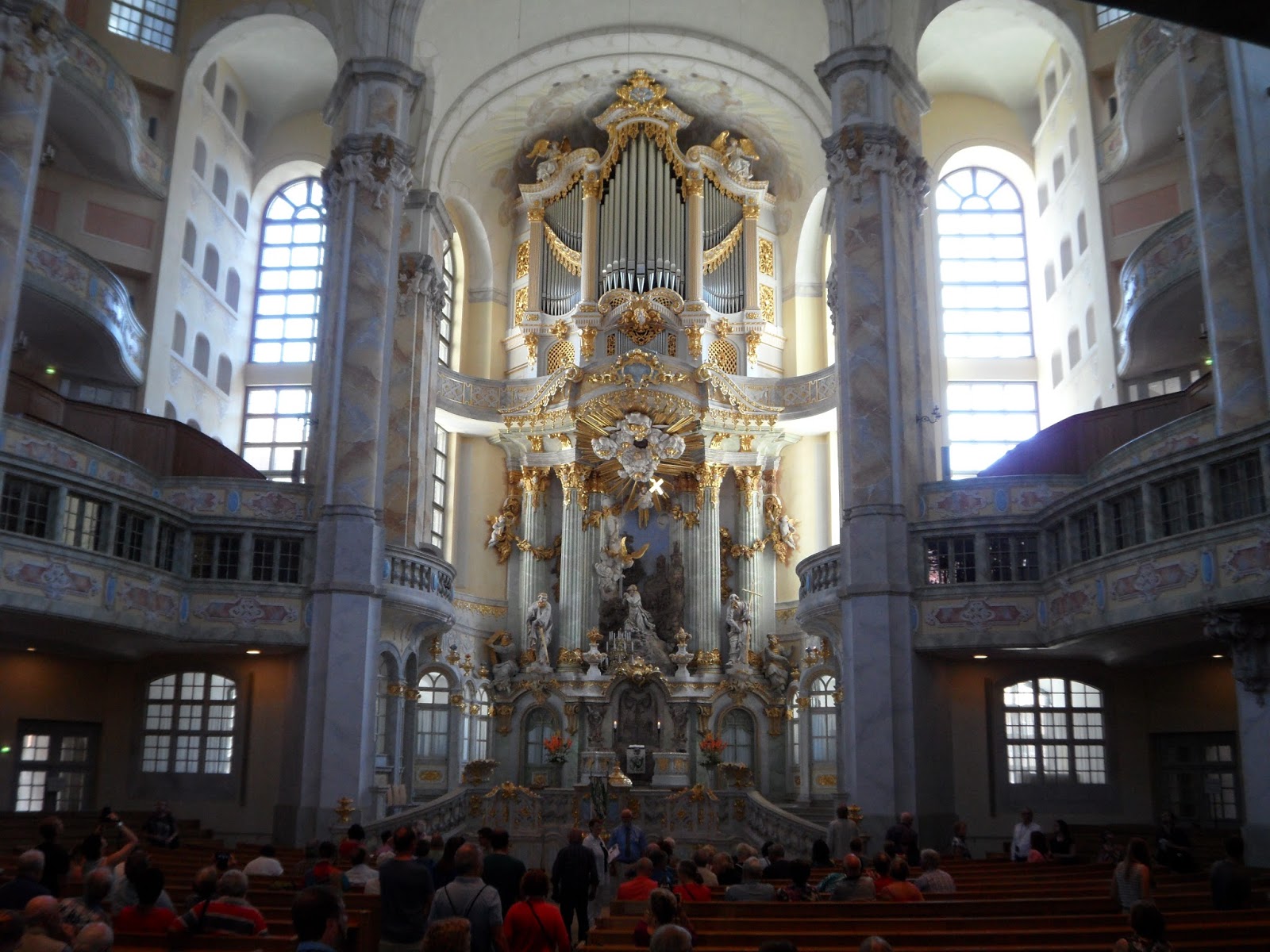
Then, the Frauenkirche.  Dresden’s Church of Our Lady has a moving history: In World War II, when air-raids wiped out the city center, the grand church collapsed into a 42 feet high pile of rubble. The ruins were left untouched until 1994, when the painstaking reconstruction of the church began. Almost completely financed by private donations from around the world, the people of Dresden could celebrate the resurrection of their Frauenkirche in 2005.


Once away from the historic city center, one can cross the Elbe River and enter a newer part of town. This area contains shopping and plenty of Soviet-era apartment blocks.  The blocks are not the best-looking buildings, although since the reunification of Germany, people have tried to make them more presentable.  Many of the apartment blocks are owned by the city and used for low-income housing. The apartments are all the same, and our guides, some of whom grew up in the buildings, tell us that they are cramped and very poorly ventilated.  The city's circus building, damaged during the war, was replaced by apartments.  A fountain commemorates the circus:


The Golden Rider...Augustus the Strong.  Now a major landmark.


A story from one of our guides.  Being out from under Soviet rule took some getting used to.  Under the Soviets, many things were not readily available, but were smuggled in.  This included money (once the family received money that had been placed inside a block of butter by a relative) and many food items. Smuggled bananas (considered an exotic and rare treat) and other items were passed from shopkeepers, literally "under the counter", to friends and relatives.  At reunification, our guide, who had never been outside the Eastern bloc, went to a "western" greengrocer.  She asked the salesperson if they had any bananas. "Why of course" was the reply.  Our guide asked how many she could buy.  When the salesperson said "as many as you want!  Your heart's desire!"  our guide almost fainted dead away.  She'd never heard of such a thing.

From Dresden, we headed upriver again toward Meissen.


Friday, August 7, 2015

Boat and Bastei

Somewhere in Viking River Cruise's handbook for employees, there's a rule that Viking never tell anyone anything that is less than optimum until everyone's on the bus with their luggage loaded. Adhering to this regulation, upon boarding the bus to Melnik to embark, we were told that the boat couldn't get that far up the River Elbe due to low water.  OMG, here we go again!!

Instead, we would be taking the scenic route along the river (that we should have been on) to Bad Schandau (hereafter referred to as "BS") for two overnights.  We prayed to all the river gods that the boat would be able to get out of BS...if not, it'd be the busses.  First day in BS, we stayed on board, visited the boat's library (OK, the boat's bookshelf) and found a book about local wines.  Jotted down the names of the local specialities and headed off to find the BS grocery store.  Great place, the Naukauf store, they had all the local wines.  From our dock next to the town parking lot, we could see that BS appeared to be a kickoff point for a number of people who were going hiking.  Walking around town, we saw photos of a rock bridge that must have been somewhere nearby.  When we got back to the boat, we realized that the next day, the shore tour was to that bridge!  Well, alrighty then, we'd go.

The park with the bridge is called Bastei.  The Bastei is a rock formation towering 194 meters above the Elbe in the Elbe Sandstone Mountains of Germany.  Reaching a height of 305 meters above sea level, the jagged rocks of the Bastei were formed by water erosion over one million years ago. They are the the major landmark of the Saxon Switzerland National Park.  They are also part of a climbing and hiking area that extends over the borders into the Bohemian Switzerland (Czech Republic).


The view of the valley was unbelievable:


And here's the Bastei Bridge, built in 1851 to replace the original wooden one:


All was right with our world after vising Bastei, especially since we had some of that local wine stashed in the room.  That evening, the boat had set up a German Buffet, complete with costumed staff members (our waiter looked great in lederhosen) and entertainment.


Then, back outside for another view of the Bastei Bridge, this time from the water, because we finally got moving!


And finally, the sunset from a moving boat:


Now we were on our way to Dresden and looking forward to it.  This was someplace we'd been wanting to see for years, ever since we saw a special about the reconstruction of the Frauenkirche after it was mostly demolished during WWII.

Wednesday, August 5, 2015

Prague

Prague was the kickoff point for our Viking River Cruise.  We caught the train from Vienna and then hoofed it to the Hilton.  Way too upscale for us, we know, but Viking was paying.  The hotel was well located, near the river, so after a quick run to the Billa store for wine, we took off to explore the river, castle district, and the old town.

The first thing we saw, on the other side of the river, looked like a giant metronome.


And that's what it is.  It's a giant, functional metronome in Letna Park, overlooking the Vltava River. It was erected in 1991, on the plinth left vacant by the destruction in 1962 of an enormous monument to former Soviet leader Joseph Stalin (the Stalin statue, too big to be moved, was blown to bits while the citizens of Prague cheered).  

A view over Prague, on the way up the hill to the castle:


At the Prague Castle, the main attraction is the towering St. Vitus Cathedral.  It's on the highest point on the hill and can be seen from all over town:


Marionettes and puppets are big business in Prague, and there were tons of shops where master craftsmen showed off their creations.  We especially liked this "kitchen witch", although she'd take up a lot of room in the kitchen:


The way back to the old town is across the ancient (and crowded) Charles Bridge:


Some detail from the bridge:


In old town, the Astronomical Clock:


And, like in Munich, leftover entry towers from when the city was walled:


During the day, we scouted for restaurants and narrowed it down to two, both nearby.  After a couple of glasses of wine, we settled on the closest one and enjoyed excellent Veal Schnitzel and the best Confit of Duck ever...along with dumplings and Czech beer, of course.

Speaking of beer, here's another reason to love Prague:


OK, next, it's onward to the boat.  The mystery builds...will we stay on the boat this time or be cast back into bus hell?


Back to Vienna in the Summertime


A return to some of the places we'd seen briefly on the earlier trips and vowed to spend more time ...here are the impressions.

Downtown, and St. Stephans:


Museum area, impressive statue of Maria Theresia (a beloved Habsburg):


Old School Streetcar:


Schoenbrunn Palace and gardens:


The heirs to the fortune, at (where else?) the beer garden:


For more on Vienna, see previous blogs.  Next stop, Prague!