Sunday, February 26, 2017

New Zealand Part 2: February 21 - 25

On to Tauranga, where we were actually docked in Maunganui.  OK, we're in love.  This is the perfect beach town.  A nice waterfront walk started near the pier and became the base track that circled Mount Maunganui and ended at the Main Beach.  The town's full of homes that are everything from cute to OMG, lots of cafes, shops, etc.  Good thing we had no tour booked, because we really enjoyed that walk.

Next we called at Napier.  Napier was a bustling port town in 1931 when the earthquake struck.  And what an earthquake...the land rose up over six feet and the bay drained, leaving flopping fish and stranded boats.  The town caught fire, all communication was lost, it was a mess.  Fortunately, one of the stranded ships was a Navy ship and they still could communicate.  The sailors went into town to fight the fire and bring first aid, while the ship called for help, which arrived quite quickly in the form of two hospital ships and more firefighters.  In the end, something like 10,000 acres of land were added to what was left of the town.  The town had to be rebuilt.  The city fathers moved all the businesses to the local park, set up a "tin town" for them, and set to building.  Art Deco was the thing at the time, and within two years, a new Deco downtown was ready to occupy.  Today, many of the buildings have been preserved and are a treat to see.


At the park where the tin town was:


Wellington, New Zealand's capital, was next.  We shuttled into town for a walk along the waterfront and through downtown.  Downtown is what you'd expect in a capital city, but the waterfront boardwalk is wonderful.  We found ourselves at Te Papa Tongarewa. Our Maori guide in Bay of Islands taught us that Te Papa means "the land", so maybe Tongarewa means museum, because this is the Museum of New Zealand.  It was free, so we thought we'd have, as they say around here, "a wee look".  They had a fabulous exhibit about Gallipoli.  We'd both just read the history of the Gallipoli conflict that took place during World War I and we ended up spending over an hour just there.  OK, back to the ship, it's wine o'clock, more good food, off to the next destination.

Wellington Waterfront:


And the next destination was Akaroa.  At anchor, we hopped from our ship to the tender to the dock to the gaff rigged Ketch "Fox II", which was built in 1920.  Our intrepid captain took us out into the bay, the caldera of an extinct volcano, under the iron mainsail.  This area is home to the smallest dolphin the the world, the Hector dolphin, and the smallest penguin in the world, the Little Blue Penguin (clever name).  We saw both, as well as fur seals and plenty of Shags (the New Zealand version of cormorants).  The wind came up a bit and we actually spent some time under the real mainsail.  Very peaceful and lots of fun.

Elephant Head Rock:


And a Little Blue Penguin:


The Fox II passing our ship:


And off to Dunedin.  We'd seen the town on the last visit, so we took a tour out onto the Otago Peninsula to visit Pukekura, home of the Northern Royal Albatross Centre.  Within view from the platform, there were about nine Albatross on nests, tending to chicks that were about a month old.  These birds were born here, and after circling the globe for four years or so, never touching land, they return here to breed.  Big birds, with wing spans of up to nine feet, their story is fascinating.  It's a little like the Galapagos here, in that these birds have been around the Park Rangers since they were born and take the Rangers as part of life, having no fear of them at all. They check on the birds, weigh the chicks, and more. Check out www.albatross.org.nz, they even have an Albatross cam on one of the nests.

The white specks are Albatross.  Sorry, photographers, wrong lens.  Oops.


We also visited the only castle in New Zealand, Larnach Castle.  Built in the 1800's by William Larnach, who owned most of the land in the area.  After several family tragedies, the remaining family sold off the good furniture and sold the castle to the state for next to nothing.  It fell into disrepair until being rescued by the Barker family around 1967.  Since then, they have acquired some of the original furnishings and restored the building.  They're at www.larnachcastle.co.nz.

Inside the castle:


Outside the castle:


Finally, our tour of NZ ended with a cruise through beautiful Milford Sound.  Then it was off to Australia by crossing the "exciting" Tasman Sea.  On our way across the Tasman, which was surprisingly calm for once, we had quite an experience:  some geezer referred to us as "young people"!!!


New Zealand Part 1: February 16 - 19

Our next stop was Bay of Islands, New Zealand.  Our tour, led by a descendant of a Maori chief with an unpronouncable name, took us first to Puketi Kauri Forest to walk the boardwalk to the ancient Kauri tree.  The Kauri trees were almost "hunted to extinction" for their hard wood, so they are protected, live a very long time, and they are huge.  Beautiful walk through a rain forest.


On the way to our next adventure, we stopped at Kawakawa for a pit stop...they have some very interesting public facilities.  Artsy, to say the least.


We also passed through the area where our guide's extended family lives (he has lots and lots of cousins) and we learned about the Maori wars that took place in the area.  It was every tribe for itself, a lot of military strategy was involved, and some chiefs even traded women for muskets in order to win the battle.

We've been to Te Anau twice now and the town is known for its glow-worm caves, but we never went.  So, in Bay of Islands we visited the Kawiti Family Glow-worm caves. The cave was discovered in the 17th century by a Maori chieftaness (apparently she didn't get traded).  Her direct descendants still own the cave and operate guided tours.  It's a live cave, or whatever you call one that's still wet and still developing.  Inside, there are thousands of New Zealand Glow worms.  These little worms weave intricate webs from their own saliva and hang at the bottom of the web.  To attract prey (small flies and midges), their tails glow blue/green.  They live for about one year, eleven months of that time being spent feeding.  Then, in a month, they breed, lay eggs, and croak.  To see them, we walked deep into the cave and doused the lights.  No photography is allowed, probably because some fool would leave his flash on and mess up the whole environment.  If you want to see them, look them up:  Arachnocampa Luminosa.  Sounds like something you'd learn at Hogwarts.

On to Auckland and a stroll to the New World grocery store that everyone knew is there, except it isn't.  Good thing we knew where the Countdown store is.  We stocked up on Minties and Barley Sugar candies and we're good to go.


American Samoa and Fiji: February 17

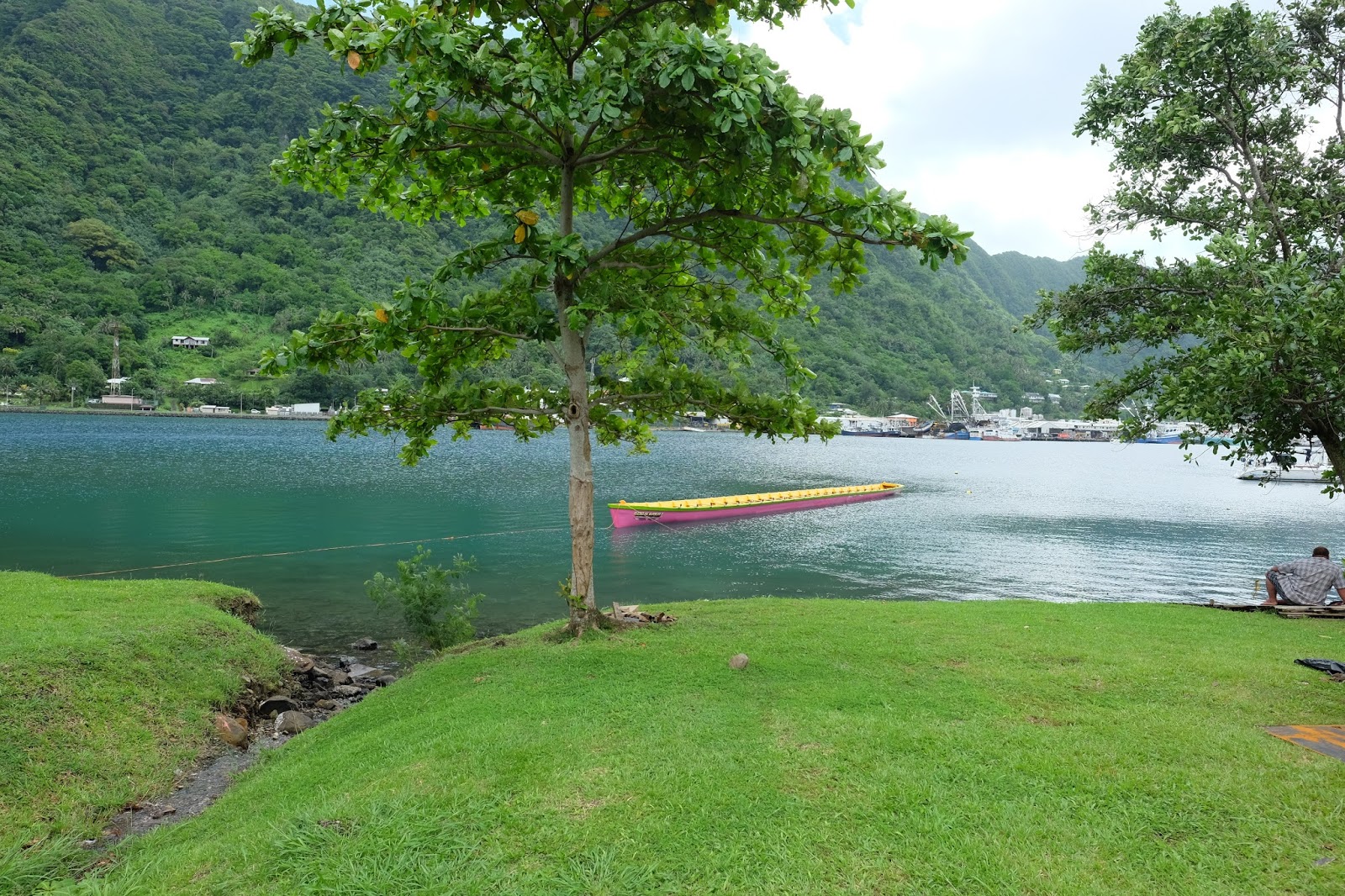
Pago Pago (pronounced, mysteriously, "pango pango"), American Samoa is beautiful but very hot and humid.  Visiting on a Saturday gave us the opportunity to watch the locals do their weekend things...picnics at the beach, shopping at the market, and riding around in the back of pickup trucks.  The Toyota pickup appeared to be the most popular beast of burden, each one passing had at least three people in the back, waving to all their friends and to us.

The other form of transportation was the local bus system which is quaint and runs people between the "city" and the "villages".  Open air buses, basically pickup trucks with the bed removed and replaced with a bus-ish structure, some looking home made, with wooden bench seating and no air conditioning took other guests on tour, but we had passed on that and took a walk.


A conversation:

Pati:  (Looking up)  A bat!
Gordon:  Where?
Pati:  No, that can't be a bat.  Bats don't soar like that.
Gordon:  Where?
Pati:  Holy shit!  That is a bat and it's huge!
Gordon:  Where?
Pati:  There!  Look!
Gordon:  Whoa!  That thing must be three feet across!

The only species native to American Samoa, these are fruit bats called Samoan Flying Foxes, and they do have wingspans of up to three feet.  They are active during the day and on the way back to the ship, we found an entire colony of them hanging upside down in the trees, chattering to each other loudly.  Photos of them are hard to get and don't do their size justice, so look them up in your encyclopedia.


Next stop, two towns in Fiji, Lautoka and Suva.  At Lautoka, we took a sightseeing tour to a nearby town called Nadi, pronounced "Nandi".  Words over here seem to sprout n's where there appear to be none.  On the way, our guide pointed out several villages and every school alongside the route.  Interestingly, all the villages have rules, or taboos.  Men may not wear hats in the villages.  Women must wear skirts and knees and shoulders must be covered.  Children must keep their place and respect their elders, or else.  These rules apply to tourists as well.  We stopped at a marina and were treated to a coconut demonstration.  This dude hulled a coconut with his teeth and then opened the nut itself by cracking it neatly in half on a rock.  No tools.


We did a little shopping in Suva, three island shirts, not knowing the exchange rate but figuring it's probably not too bad.  Believe it or not, the Fijian Dollar is worth 48 cents U.S.  Talk about bargains!  Finally, we'll say this.  If you're thinking about going to Fiji to sit in a five-star hotel on the beach, go for it.  Otherwise, fahgeddaboutit.

Suva:


Fiji sunset:


Friday, February 10, 2017

Nuku Hiva to Bora Bora: February 10


We were right.  Nothing to see in Nuku Hiva, save for the locals blowing us a welcome on conch shells.  One thing hasn't changed since our last visit to the Marquesas.  It's hotter than hell.

Next stop was Rangiroa (pronounced with a hard "g"), French Polynesia.  Rangiroa is an atoll that is so wide that one can't see the other side of the circle.  The inhabited areas, however, are very narrow and it's easy to walk from one side of the island to the other in about five or ten minutes.  We took a tour on the Bateau Fond de Verre. Non parle pas Francais?  Look it up.  Anyway, this was more like the Leaky Tiki.  They needed that silicone sealant as seen on TV.  But what fun!  We saw coral, tropical fish of all sorts, Moray Eels, sharks, and our brave guide under the boat feeding them all.  Not only that, but the guides were talented singers and palm frond weavers.  Pati has a new handmade hat.

We'd been to Papeete before so we didn't tour, just took a walk along the waterfront and made a visit to the shopping areas. The waterfront is a pleasant walk lined with beautiful plants and flowers.   We knew we were in a French holding when we spotted the Carrefour.


Last time, everyone was buying the Polynesian specialty, black pearls.  This time, we got on board and Pati bought a black pearl necklace that was attractively priced.

So, if you're thinking about going to French Polynesia, think about Bora Bora.  This is the place with the hotel rooms on pilings out over the water.  There's nothing to do but snorkel, fish, or sit on the beach but it's beautiful.  Another glass-bottomed boat trip, this one much more professional, took us to see fish, fish, fish, coral, eels, and sting rays.  On the trip from Papeete to Bora Bora, we realized that black pearl earrings were needed.  So we made a visit to the Bora Bora black pearl company for earrings that were not as attractively priced. Once again, we knew we were in France when we spotted the Super U.

Two days at sea will take us from Bora Bora to Pago Pago, thank you thank you.


Thursday, February 2, 2017

Aloha and Mahalo: February 2


From San Diego, five rough days at sea took us to Hawaii.  First stop, Honolulu, and we had an "event", the first of three planned for this trip.  We were greeted with a lei at the Iolani Palace.  After a short tour, the palace guard performed for us and we were treated to Hawaiian drinks and snacks while we watched a historic show of fashions from the state's rich history.  Who knew that Portuguese from our favorite island of Madeira migrated to Hawaii?  It's amazing about Hawaiians...what we mainlanders don't understand is that many of them are still unhappy about the overthrow of their royalty in the late 1800's, which they blame on us.  And then there was that little incident at Pearl Harbor.


Next stop was Lahaina on Maui.  The Pacific Humpback whales migrate south to Maui each winter to start their families.  We were hoping that the whales were still around this late in January.  They were!  Almost the first thing we saw when we opened our curtains in the morning was a whale spout.  Over the course of the day we saw a lot of whale activity as we drove along the coast to a tropical plantation and the Maui Ocean Center.  Very interesting aquarium.


We were supposed to visit Nawiliwili on Kauai.  While getting dressed, we passed an Oceania (sister company to Regent) ship going the opposite direction and shortly after that, wondered why our ship was listing so much.  The list, we found out, was caused by a great big 180 degree turn and away we went, following Oceania.  The channel into the port is apparently quite narrow, and the sea too rough.  So much for Kauai, and on to the Big Island.

At Hilo, we bravely went off to another volcano, hoping this experience would be more pleasant than the last one.   Hawaii Volcanoes National Park is located on the Kilauea volcano, which is quite alive and active.  Our guide promised us that we'd see an eruption.  How comforting.  She was right, though, and from the Jaggar Museum's porch, we had a view of the Kilauea Caldera and the Halema'uma'u crater which is erupting constantly.


We took a five mile hike that passed through the Thurston Lava Tube and then through rain forest surrounding the Kilauea Iki crater, currently dormant, the last eruption was in 1951.  The trail deposits one at the crater floor,  a "lava lake".  It's one mile across the lava to the other side and then you climb back out via a switchback trail. It was a challenging walk taken in perfect weather and we really enjoyed it.  When we arrived back at the trailhead, we met up with a bunch of our crew members who were on a crew tour to the volcanoes and they were having a grand time.

The lava tube:


The crater:

Inside the crater floor:


Four days at sea will take us to Nuku Hiva in the Marquesas Islands.  Last time we were there, the locals put on a big feast and show, but maybe this ship isn't big enough to get the full treatment.  Bottom line is that there isn't much to see on Nuku Hiva, probably just chickens and coconut retrievers, but we'll see.

Monday, January 23, 2017

January 23, The Seat Belt Sign is On


We did stop in Acapulco, but we value our lives, so we stayed aboard ship.  The Cruise Director told us that the company hadn't called in Acapulco for some time because of the dangerous nature of the place and he was surprised that it's back on the list.  There were no reported incidents, so maybe things have improved.

San Diego greeted us with weather that's almost unheard of.  The old song about it doesn't rain in California, it Pours?  Correct.  We did get to spend the afternoon with cousin David and his wife Mary Kate, so that really helped cheer us up.  We had an overnight at San Diego since it was the end of the first segment.  Some people left, new folks joined, and the ship was fully occupied.  490 pax and 367 crew.

So Customs has a new game called zero something or other.  The game is that all the passengers have to get off the ship by a particular time, or else someone pays a fine.  So our instruction sheet said "if you are not planning to go ashore, go ashore by nine a.m.".  What?  The zero game was cancelled, however.  We figured that they got a good look at the gang on this ship and decided that making us all get off would result in at least half a dozen silver alerts.

Fast forward to today.  Enroute Hawaii and we are on the back side of that weather system.  Very rough seas.  Everything is tied down and it's interesting to watch the bar people juggle the drink trays.  Our hats are off to the wait staff.

Saturday, January 14, 2017

From Costa Rica to Guatemala, January 14


We finally got off the ship in Golfito, Costa Rica and toured Golfito National Wildlife Refuge.  Wildlife wise, it left something to be desired.  Saw a few Spider Monkeys, some hummingbirds, and a Costa Rican millipede. One thing we learned during the snack stop is that fresh pineapple grown nearby is a lot better than the ones we buy at home. A tip from our guide:  buying the pineapple, look for one that's green in color.  Cut a little off of the bottom, just enough to make a round port.  Place it in about one cup of water, then wait overnight.  The pineapple will rehydrate itself and taste better.  We learned that the best coffee in the world comes from Costa Rica.

Next stop, Puntarenas, Costa Rica.  We drove quite a ways inland to San Luis Park for a walk in the clouds.  Literally.  This is a cloud rain forest and one crosses a number of suspension bridges on the way to the stream at the bottom of the area.  Beautiful foliage all around, and they host a butterfly garden and a separate hummingbird garden.  Lots of fun, but hummingbirds don't pose well for pictures.

Onward to Corinto, Nicaragua.  Here, we are proud to say, we survived the Cerro Negro Trek.  This whole area is rife with volcanos.  Cerro Negro is one that used as an attraction.  There's ziplining, but the big deal is to climb to the top and then slide down the side of the thing on a board.  Just a plain old board about 18 inches across and five feet long.  No, we didn't do that.

After a fairly treacherous climb up the volcano in 40 mph winds, we were treated to beautiful views, many of our flying hats and sunglasses.  No, really, it was beautiful.


So, to descend without the board, you step down the same side of the mountain as the sliders.  Think of walking straight downhill in a snow bowl with powder...only in this case it's volcanic ash.  We have a new respect for the ash, since about a pound of it was inside each of our shoes when we got to the bottom.  Here's Pati hot-footing it down.


Our sympathies to the stewards who wound up cleaning half a volcano off of the balconies.  We learned that the best coffee in the world comes from Nicaragua.


We sailed overnight to Puerto Quetzal, Guatemala.  The day before was Friday the 13th, especially for Seabourn Cruise Line.  Their Seabourn Odyssey was sitting in port with a mechanical failure, and not a soul in sight.  We took it easier in Guatemala, visiting the Finca El Barretal Coffee Plantation.  The property was originally owned by the President of Guatemala (see President, read Dictator) who got ousted in 1944 after his form of Socialism stopped working for the masses, and especially the military.  Anyway, we learned everything about how coffee is grown and processed, and we learned that the best coffee in the world comes from Guatemala.