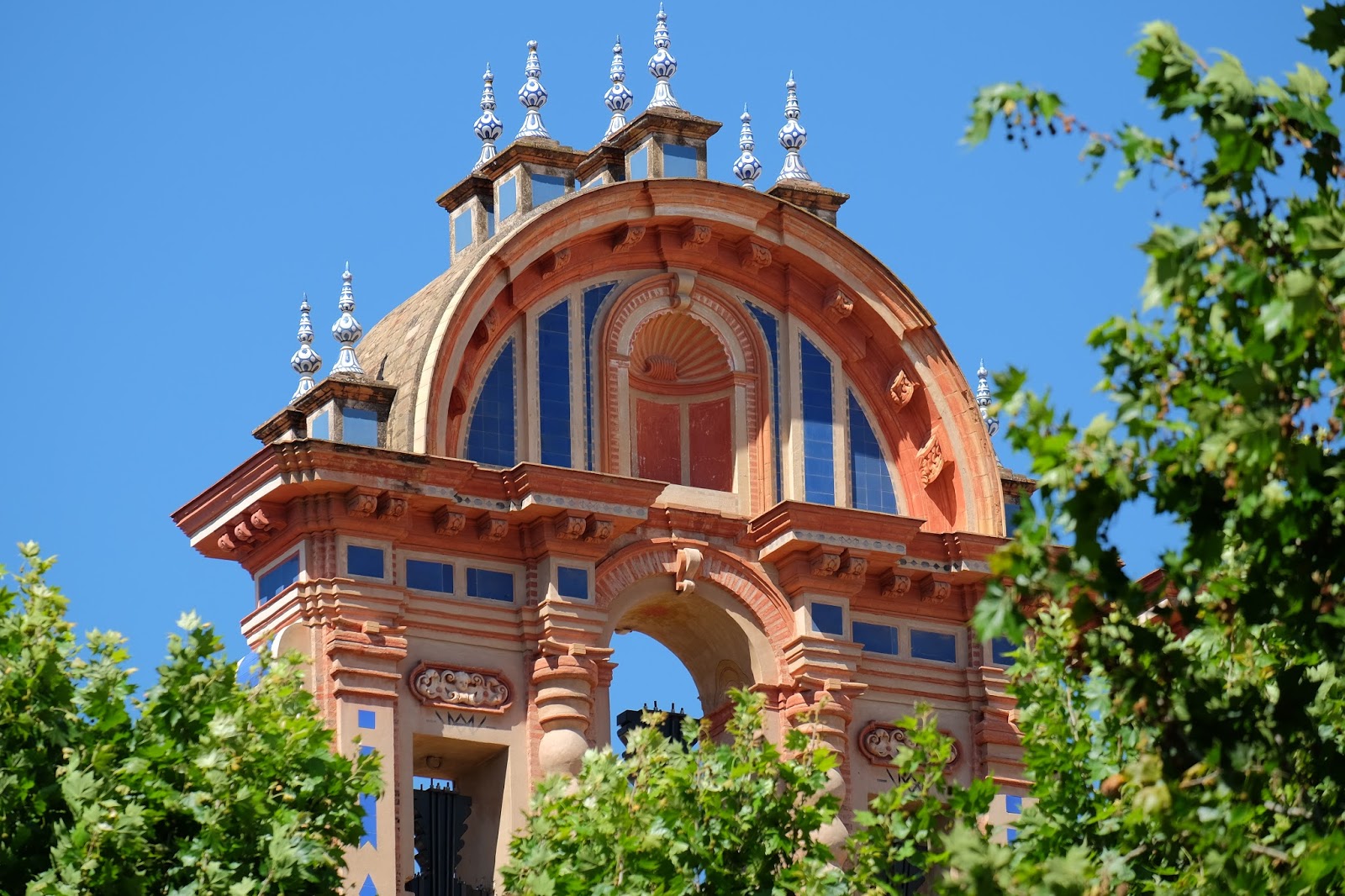
The next day, we were docked at Cadiz, Spain. On offer was a transportation only trip to Seville. This meant we had all day to explore the town on our own, and we did just that.
The Reales Alcazares:
The Cathedral:
Don Juan!
A typical street:
Gorgeous architecture:
And, local history:
It was a major holiday, as the Seville April Fair was in full swing. All around were people in their local finery, being transported by horses and buggies.
Seville exceeded our expectations. It was a beautiful day and a beautiful city. And if you ever go there, don't miss the Spanish Olive Oil Tortas at Ines Rosales. You can buy a pack to go. We'd love to go back.
Wednesday, June 7, 2017
Monday, June 5, 2017
Gibraltar, April 30
We were in Gibraltar before, on the cruise where Pati broke her toe. That time, the weather wasn't very good and she wasn't much for walking around, so we stayed aboard the ship. This time, we wanted to know what one does in Gibraltar, anyway? Why, head for the upper rock, of course! You knew that. Two ways to get up to the top: drive a car or take a cotton-pickin, scarier than shit, cable car up the side of the mountain. Guess how we got there? Gordon's still trying to get Pati's fingernail marks out of his arm...this was worse than the other one.
OK, at the top there's a lookout.
Then it's off to see the Barbary Apes. These guys own the top of the rock, they are very well cared for, and they have the right of way on the handrails, which are their highways. If the stupid tourists get in the way, the apes just push 'em out of the way and keep going. Lots of fun!
One place that the apes don't go is into St. Michael's cave. Why? No food in there. But the cave is very spacious, lit spectacularly, and it's even used for events and concerts.
Last things to see were the tunnels built into the rock by the military during the wars. Naturally the cliff side was an excellent spot for a gunnery placement.
And a very interesting view of the airport! See the EasyJet airplane landing?
Onward to Cadiz, Spain.
OK, at the top there's a lookout.
Then it's off to see the Barbary Apes. These guys own the top of the rock, they are very well cared for, and they have the right of way on the handrails, which are their highways. If the stupid tourists get in the way, the apes just push 'em out of the way and keep going. Lots of fun!
One place that the apes don't go is into St. Michael's cave. Why? No food in there. But the cave is very spacious, lit spectacularly, and it's even used for events and concerts.
Last things to see were the tunnels built into the rock by the military during the wars. Naturally the cliff side was an excellent spot for a gunnery placement.
And a very interesting view of the airport! See the EasyJet airplane landing?
Onward to Cadiz, Spain.
Marseille and Barcelona, April 27
There isn't that much to see in Marseille once you've hoofed it up to the church on the hill, which we've done, thank you. We'd also been to Avignon before, but had not gone inside the Pope's Palace, so this was our chance.
The weather was lousy. Tour guide said this is the coldest April day they've had in ages. The wind was howling and it was in the 50's, so we were really glad to get inside that palace and out of the cold. In fact, since we'd already seen the rest of Avignon, we sat down on a bench in the Pope's dining hall and ate a sandwich...and we stayed there until it was time to hook up with the rest of the group.
Although impressive from the outside, there's not much inside the palace, save for well-preserved statues and frescoes. I guess they sent all the opulent stuff back to the Vatican when it was safe for old Clement and his staff to go home. It's an interesting place, just the same.
On the way back, we stopped in a really cute little walled town called Le Baux. If it hadn't been so cold, it would have been fun to explore the town further, but we did walk up and down the main street and check out the shops.
On to Barcelona. It was a beautiful day and we set out for Corte Ingles (needed saffron), Desigual (needed to shop), Decathlon (more Kalenji clothes), and the market (needed dried figs and Marcona almonds). Mission accomplished, we skipped the wait for the shuttle bus and walked back to the ship. Most people would never walk that far, but we did pass several crew members who were shocked to see us walking the distance.
Next stop, Gibraltar!
The weather was lousy. Tour guide said this is the coldest April day they've had in ages. The wind was howling and it was in the 50's, so we were really glad to get inside that palace and out of the cold. In fact, since we'd already seen the rest of Avignon, we sat down on a bench in the Pope's dining hall and ate a sandwich...and we stayed there until it was time to hook up with the rest of the group.
Although impressive from the outside, there's not much inside the palace, save for well-preserved statues and frescoes. I guess they sent all the opulent stuff back to the Vatican when it was safe for old Clement and his staff to go home. It's an interesting place, just the same.
On the way back, we stopped in a really cute little walled town called Le Baux. If it hadn't been so cold, it would have been fun to explore the town further, but we did walk up and down the main street and check out the shops.
On to Barcelona. It was a beautiful day and we set out for Corte Ingles (needed saffron), Desigual (needed to shop), Decathlon (more Kalenji clothes), and the market (needed dried figs and Marcona almonds). Mission accomplished, we skipped the wait for the shuttle bus and walked back to the ship. Most people would never walk that far, but we did pass several crew members who were shocked to see us walking the distance.
Next stop, Gibraltar!
Civitavecchia and on to Monaco, April 25
While most people took off for day-long tours of Rome, we passed on that since we've been there a couple of times already and couldn't imagine what we needed to see again. We were intrigued by a tour to nearby Ostia Antica. Ostia, about an hour south of the port, is one giant archelogical dig.
Once a thriving Roman city covering many acres, it seems that an earthquake during those times changed the route of the Tiber River and the town was eventually abandoned for that and other reasons and left to be covered in silt. Many of the ruins are fairly intact and have been uncovered by hand over many years, often by volunteers from various universities, and according to satellite information, there's a lot left to go.
The city had several temples, several thermal baths, a fire department, a theater, big houses, little houses, condominiums, bakeries, and a cemetery. Alas, no acropolis, but then again, we're talking Rome, not Greece. Check out their website: http://www.ostia-antica.org/
At the amphitheater:
So many ruins!
An inlaid floor:
The shopping street:
Yup. It's the public toilets:
Next stop was Monaco. I think we've posted enough pictures of Monaco. We arrived close to noon and there was a front passing through, wind howling, so we had to wait for a while before we could get on to the dock (it's a narrow approach). Finally, the intrepid Captain called for a tugboat or two and we made it in. The wind let up, it warmed up, and we went to our usual shopping spots to stock up on toothpaste, duck pate, etc. No trip to Monaco is complete without surprising our friend Franco at his Caves & Gourmandises shop near the port.
There was an event that night for the world cruisers. It was listed as dinner at Cafe de Paris and a visit to the famous Monte-Carlo casino. That turned out not to be the case...they did have dinner at Cafe de, but the casino wasn't included in the deal, plus we were told at one time that we'd be at anchor! We decided not to board a tender wearing our best attire, so we backed out of the event. Good thing, because as we arrived back at the ship after wandering around, it threatened rain (no surprise in Monaco). Just as the event-goers walked off the ship, the skies opened up. Don't know what happened after that, but we heard about rubber chicken, only one-half hour for the casino and one had to pay to get in, more rain, and the cruise director fell flat on his duff on the slippery steps. We had a lovely dinner in Compass Rose.
OK, we were headed for Marseille.
Once a thriving Roman city covering many acres, it seems that an earthquake during those times changed the route of the Tiber River and the town was eventually abandoned for that and other reasons and left to be covered in silt. Many of the ruins are fairly intact and have been uncovered by hand over many years, often by volunteers from various universities, and according to satellite information, there's a lot left to go.
The city had several temples, several thermal baths, a fire department, a theater, big houses, little houses, condominiums, bakeries, and a cemetery. Alas, no acropolis, but then again, we're talking Rome, not Greece. Check out their website: http://www.ostia-antica.org/
At the amphitheater:
So many ruins!
An inlaid floor:
The shopping street:
Yup. It's the public toilets:
Next stop was Monaco. I think we've posted enough pictures of Monaco. We arrived close to noon and there was a front passing through, wind howling, so we had to wait for a while before we could get on to the dock (it's a narrow approach). Finally, the intrepid Captain called for a tugboat or two and we made it in. The wind let up, it warmed up, and we went to our usual shopping spots to stock up on toothpaste, duck pate, etc. No trip to Monaco is complete without surprising our friend Franco at his Caves & Gourmandises shop near the port.
There was an event that night for the world cruisers. It was listed as dinner at Cafe de Paris and a visit to the famous Monte-Carlo casino. That turned out not to be the case...they did have dinner at Cafe de, but the casino wasn't included in the deal, plus we were told at one time that we'd be at anchor! We decided not to board a tender wearing our best attire, so we backed out of the event. Good thing, because as we arrived back at the ship after wandering around, it threatened rain (no surprise in Monaco). Just as the event-goers walked off the ship, the skies opened up. Don't know what happened after that, but we heard about rubber chicken, only one-half hour for the casino and one had to pay to get in, more rain, and the cruise director fell flat on his duff on the slippery steps. We had a lovely dinner in Compass Rose.
OK, we were headed for Marseille.
Wednesday, May 3, 2017
Greece, Part 2: Athens and On Toward Italy
Athens. Finally. Remember we got cancelled out of Athens many moons ago?
So what do you do in Athens? Why, go to the Acropolis! Of course, this is THE acropolis and it's dedicated to the Greek gods, in general.
Interesting, listening to Greek opinion of the financial crisis that they recently faced. A little grifiti about the subject:
It seems as though they didn't see any crisis until the banks were closed. Then they raised hell about the banks. Once the banks were opened again, they didn't see any crisis anymore. We kind of got that in general, they don't have any concern about the condition or politics of the country or its neighbors. We began to understand why they call these countries "Club Med". Don't worry, drink wine. One thing they are concerned about and can't let go. The carvings from the top of the Acropolis are still in the British Museum, having been "stolen" a long time ago. Greece wants their carvings back, yesterday, period. Good luck with that.
After Athens, we visited two other islands: the G place and the Z place. Most of us couldn't remember either of the names.
At the G place (Gythion), we visited the Diros caves, with a quick pit stop at a little village on the way.
The Diros caves are alive and wet. In fact, the floor has anywhere from a foot to maybe six feet of water over it. They were explored between 1900 and 1960 and fossilized bones of panthers, hyenas, lions, deer and hippopotamus bones were found, along with pottery near the entrance, indicating the presence of man. Opened to the public in 1967, the tour was conducted in a little boat and the driver pushed or paddled us through the cave. Beautiful!
At the end of the tour, we strolled around Gythion's waterfront and found a bakery. The biggest and best Baklava ever, brought back to the ship and enjoyed with a cup of coffee from the bar.
Onward to the Z place (Zakynthos). It's another waterfront village and we decided to make a sea day of it, so we did not go into town. This would give us two sea days, one of which took us through the very narrow Messina Straight at the toe of the Italian boot. We viewed Mt. Etna, which constantly steams, the straight itself, and another volcano called Stromboli that also steams constantly. We even thought that we could occasionally see a bit of red glow. Believe it or not, people have built houses on the volcano. What???
Buongiorno, Italy! Next stop is Civitavecchia, and unlike some of our fellow passengers, let's not slaughter the name, it's pronounced "chee-vee-ta-vek-ya". The word means "old city".
So what do you do in Athens? Why, go to the Acropolis! Of course, this is THE acropolis and it's dedicated to the Greek gods, in general.
Interesting, listening to Greek opinion of the financial crisis that they recently faced. A little grifiti about the subject:
It seems as though they didn't see any crisis until the banks were closed. Then they raised hell about the banks. Once the banks were opened again, they didn't see any crisis anymore. We kind of got that in general, they don't have any concern about the condition or politics of the country or its neighbors. We began to understand why they call these countries "Club Med". Don't worry, drink wine. One thing they are concerned about and can't let go. The carvings from the top of the Acropolis are still in the British Museum, having been "stolen" a long time ago. Greece wants their carvings back, yesterday, period. Good luck with that.
After Athens, we visited two other islands: the G place and the Z place. Most of us couldn't remember either of the names.
At the G place (Gythion), we visited the Diros caves, with a quick pit stop at a little village on the way.
The Diros caves are alive and wet. In fact, the floor has anywhere from a foot to maybe six feet of water over it. They were explored between 1900 and 1960 and fossilized bones of panthers, hyenas, lions, deer and hippopotamus bones were found, along with pottery near the entrance, indicating the presence of man. Opened to the public in 1967, the tour was conducted in a little boat and the driver pushed or paddled us through the cave. Beautiful!
At the end of the tour, we strolled around Gythion's waterfront and found a bakery. The biggest and best Baklava ever, brought back to the ship and enjoyed with a cup of coffee from the bar.
Onward to the Z place (Zakynthos). It's another waterfront village and we decided to make a sea day of it, so we did not go into town. This would give us two sea days, one of which took us through the very narrow Messina Straight at the toe of the Italian boot. We viewed Mt. Etna, which constantly steams, the straight itself, and another volcano called Stromboli that also steams constantly. We even thought that we could occasionally see a bit of red glow. Believe it or not, people have built houses on the volcano. What???
Buongiorno, Italy! Next stop is Civitavecchia, and unlike some of our fellow passengers, let's not slaughter the name, it's pronounced "chee-vee-ta-vek-ya". The word means "old city".
Greece, Part 1: April's Winding Down
At Rhodes, we hopped on the bus to drive to the Acropolis of Lindos (see? everyone has an acropolis!). This temple is dedicated to Athena. It's a long climb up lots of steps to the top, and there's two ways to do it. Either ride a donkey or hoof it. We went on foot.
Descending back down to the parking lot, we found a field with an open gate and barged right in. Turns out that the field was the donkey's break room and several of them were wandering around. The view of the Acropolis was great, though.
Approaching Santorini Island, it looks as though the hilltops are covered with snow, but the snow turns out to be the island's villages. Everyone has seen the pictures of the whitewashed villages with the blue or white roofs. There is only one place where most of the ships come in these days, and we didn't even drop anchor. Santorini sends out their own very nice tenders to bring people to shore. We headed off the the village of Oia (pronounced eee-ah). Not much to do in Oia except take pictures or shop. Shopping, by the way, seemed to be some people's life's work and it almost got to be a competition. We took pictures. Oia:
While we were in Oia, the ship moved to the main city of Santorini, Fira, and dropped anchor. We hopped back onto the bus (bus, bus, bus) and drove over to Fira for a walk around. It's picturesque.
Fira's at the top of the hill, and there's only one way down the hill to the dock, a cable car. We HATE cable cars, and apparently the four Koreans sharing the car with us felt the same because their eyes were the size of saucers.
Descending back down to the parking lot, we found a field with an open gate and barged right in. Turns out that the field was the donkey's break room and several of them were wandering around. The view of the Acropolis was great, though.
Approaching Santorini Island, it looks as though the hilltops are covered with snow, but the snow turns out to be the island's villages. Everyone has seen the pictures of the whitewashed villages with the blue or white roofs. There is only one place where most of the ships come in these days, and we didn't even drop anchor. Santorini sends out their own very nice tenders to bring people to shore. We headed off the the village of Oia (pronounced eee-ah). Not much to do in Oia except take pictures or shop. Shopping, by the way, seemed to be some people's life's work and it almost got to be a competition. We took pictures. Oia:
While we were in Oia, the ship moved to the main city of Santorini, Fira, and dropped anchor. We hopped back onto the bus (bus, bus, bus) and drove over to Fira for a walk around. It's picturesque.
Fira's at the top of the hill, and there's only one way down the hill to the dock, a cable car. We HATE cable cars, and apparently the four Koreans sharing the car with us felt the same because their eyes were the size of saucers.
Cyprus: April 24
Docked at Limassol, we charged back onto the buses for a trip to Kourion. There, we visited the Theater and the Eustolius house ruins. The theater was probably built towards the end of the 2nd century BC and originally had a circular orchestra. Due to earthquakes, it was damaged repeatedly and has been restored a number of times. The current theater is, for the most part, a modern reconstruction, but we got the idea.
The House of Eustolius was initially built during the early Roman period and remodeled around 450 AD. The remains of important mosaic floors are well preserved in this house. Don't know exactly what's important about them, but that's what the brochure said!
We also visied the Sanctuary of Apollo Hylates, at the Acropolis of Kourion. Now, nearly every city had (actually, has) an acropolis. It basically means the highest point in the area. On the acropolis, one builds his temple to the chosen god or gods. Apollo won the toss at Kourion. The history of this place goes back as far as 2000 BC, but most of what survives is of Roman construction.
And then we were in for an interesting stop at a mountain village called Omodos. Like all villages, this one has main street covered with gift shops and cafes. There is a monastery that sponsors some very peculiar activities, especially around Easter. On the Tuesday after Easter, the priest grabs a large cross and walks through the town, stopping at each and every open door to deliver a blessing (for a donation, of course).
After the blessing is received, the owner of the open door grabs a rifle, runs outside, and fires into the air. Turns out that what they do is use some type of noisemaker cartridges that they fire off in between beers, while watching the tourists jump out of their skin. We even heard some automatic weapons. Not really comforting to the visitor. One mistake and someone loses an eye...
Apparently the locals used to also build a huge bonfire and burn Judas in effigy. The authorities have mostly got that stopped, but they're having trouble trying to stop the celebratory gunfire.
Onward to Greece!
The House of Eustolius was initially built during the early Roman period and remodeled around 450 AD. The remains of important mosaic floors are well preserved in this house. Don't know exactly what's important about them, but that's what the brochure said!
We also visied the Sanctuary of Apollo Hylates, at the Acropolis of Kourion. Now, nearly every city had (actually, has) an acropolis. It basically means the highest point in the area. On the acropolis, one builds his temple to the chosen god or gods. Apollo won the toss at Kourion. The history of this place goes back as far as 2000 BC, but most of what survives is of Roman construction.
And then we were in for an interesting stop at a mountain village called Omodos. Like all villages, this one has main street covered with gift shops and cafes. There is a monastery that sponsors some very peculiar activities, especially around Easter. On the Tuesday after Easter, the priest grabs a large cross and walks through the town, stopping at each and every open door to deliver a blessing (for a donation, of course).
After the blessing is received, the owner of the open door grabs a rifle, runs outside, and fires into the air. Turns out that what they do is use some type of noisemaker cartridges that they fire off in between beers, while watching the tourists jump out of their skin. We even heard some automatic weapons. Not really comforting to the visitor. One mistake and someone loses an eye...
Apparently the locals used to also build a huge bonfire and burn Judas in effigy. The authorities have mostly got that stopped, but they're having trouble trying to stop the celebratory gunfire.
Onward to Greece!
Subscribe to:
Posts (Atom)